


Empowering legal professionals
Make us your partner, to help you gain the competitive advantage you seek.
Make us your partner, to help you gain the competitive advantage you seek.
.png)
Chinese and Gulf (UAE) capital dominate Asia-linked investment growth into Zimbabwe over the past five years.
Chinese licence values have roughly quadrupled, and UAE investment has reached US$1.4 billion since 2022. India remains a distant but growing third.
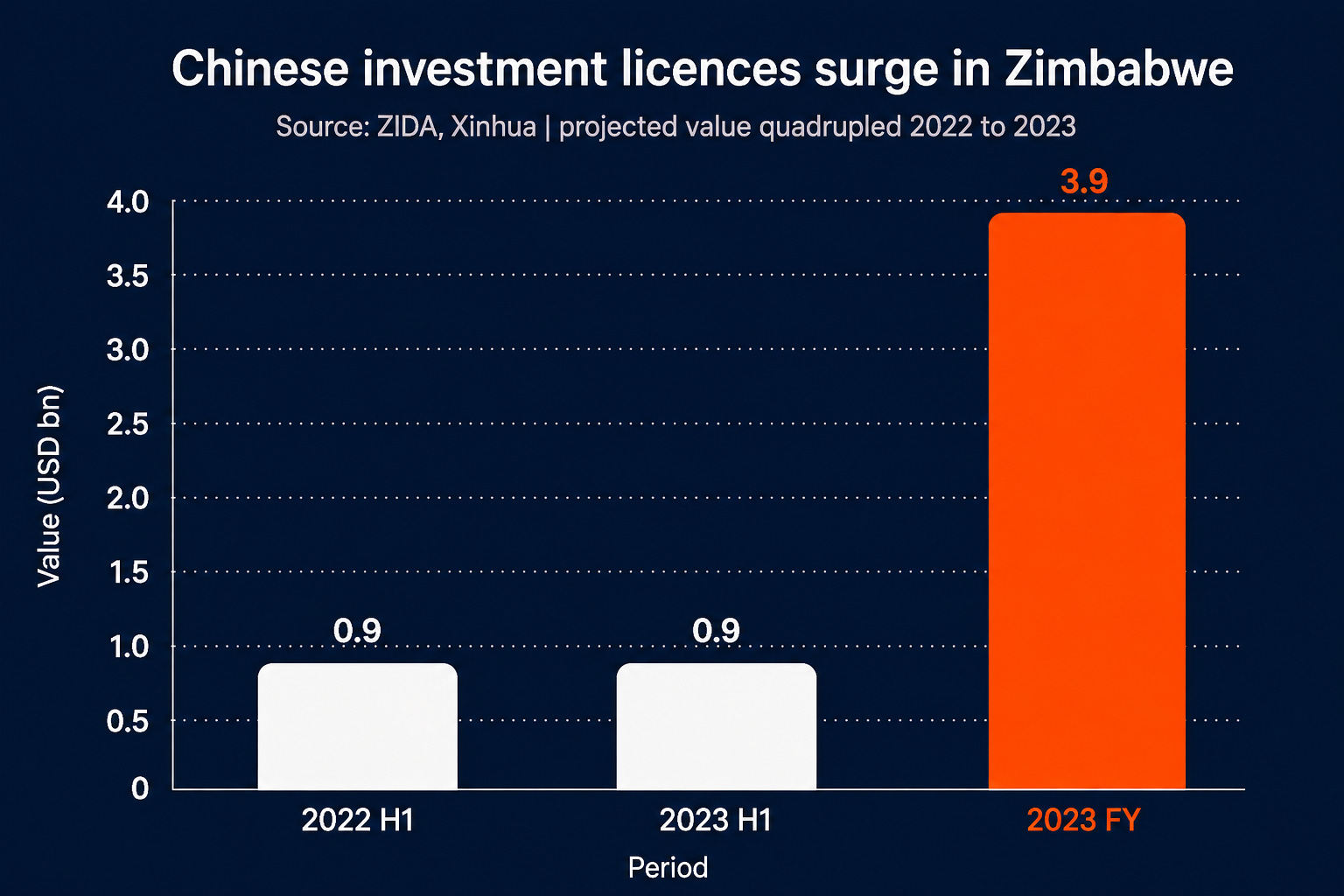
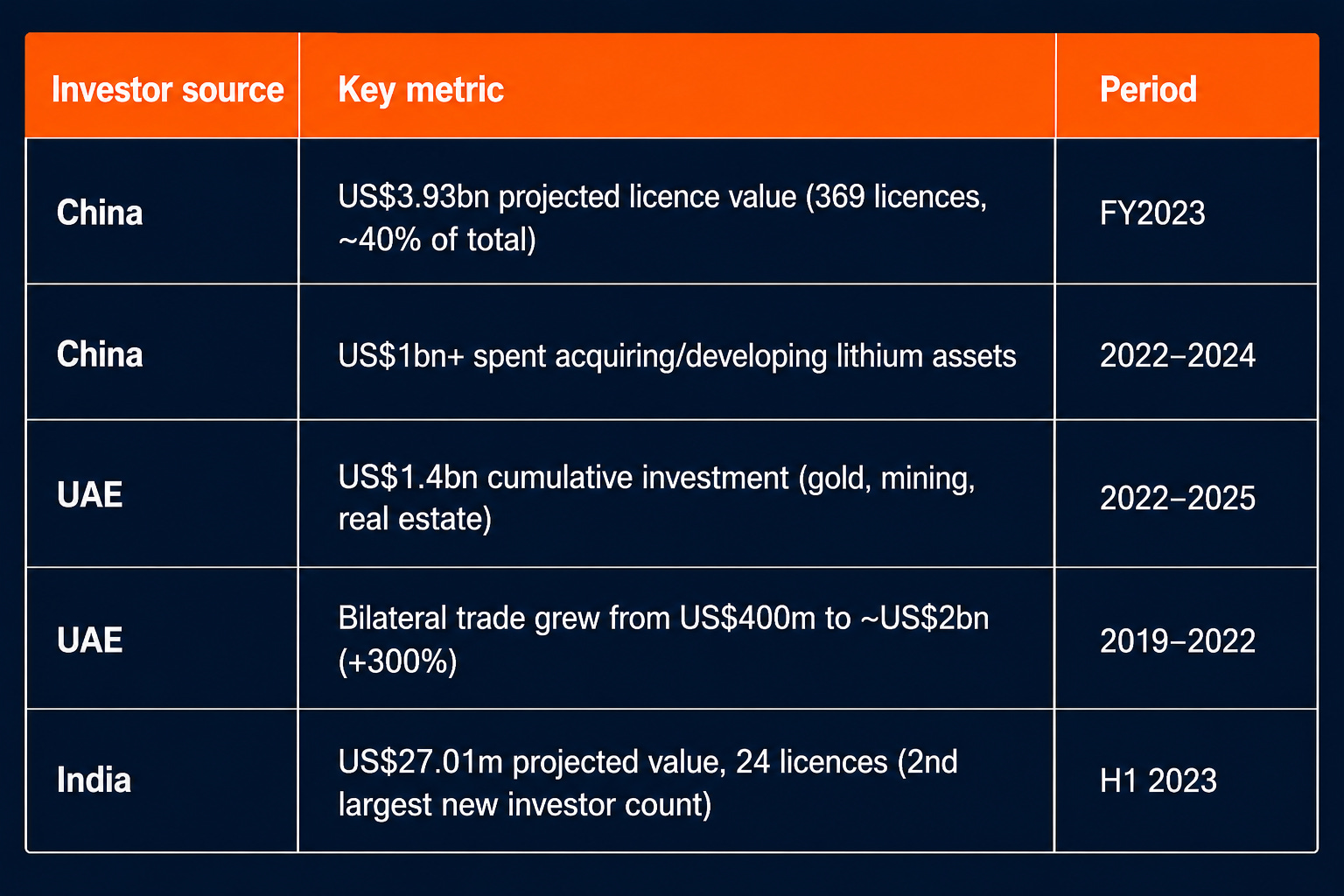
China remains by far the largest Asian investor. ZIDA-projected investment value from Chinese licence applicants rose from US$939.5 million in H1 2022 to US$948.67 million in H1 2023. Full-year 2023 Chinese-linked projected investment hit US$3.93 billion across 369 licences - accounting for roughly 40% of Zimbabwe’s total projected investment value that year.
Cumulatively, Chinese companies have spent over US$1 billion since 2022 acquiring and developing lithium assets alone - including Zhejiang Huayou Cobalt’s US$422 million purchase of the Arcadia mine, Sinomine’s US$180 million acquisition of Bikita Minerals plus a further US$200 million in processing capex, and Chengxin Lithium’s stake in the Sabi Star mine.
On the state-finance side, AidData’s tracking shows China directed US$5.5 billion in loan and grant commitments across 225 projects in Zimbabwe between 2000 and 2022. Though this is development finance rather than pure equity FDI, Zimbabwe’s poor credit record has actually constrained fresh Chinese lending in recent years.
A newer flagship deal is the US$2.8 billion Chinese-backed battery metals industrial park announced in late 2023, aimed at building a full lithium-ion battery value chain northwest of Harare.
The more striking five-year trend is the UAE’s rise to become Zimbabwe’s largest trading and investment partner, overtaking China. UAE-Zimbabwe bilateral trade grew from roughly US$400 million in 2019 to nearly US$2 billion by 2022 (almost 300% growth). Emirati investment in gold trading, mining, and real estate reached US$1.4 billion cumulatively by 2025.
This positions the UAE as a stabilising counterweight at a time when Western engagement remains limited. Dubai is now the dominant destination for Zimbabwean gold exports via the Dubai Gold & Commodities Exchange
India’s presence is far smaller but growing steadily. In H1 2023, India ranked second among new ZIDA-licensed investor countries (after China) with 24 licences worth a projected US$27.01 million - a fraction of Chinese figures but notable relative to most other single countries.
Investment Climate Statement data also confirms India as a recurring, if minor, source of new licensing activity alongside Russia and Iran.
Total investment licensing has accelerated sharply, providing useful context for Asian flows specifically. ZIDA issued 207 new licences in Q1 2025 (up 44.8% year-on-year), 190 in Q2 2025 (up 23.4%), and 203 in Q3 2025 (up 20.8%), with cumulative January to August 2025 projected investment value reaching US$9.97 billion, nearly triple the US$3.40 billion recorded in the same period of 2024.
By Q3 2025, ZIDA had licensed 2,197 cumulative projects worth an aggregate projected US$38.66 billion, of which US$1.47 billion had already materialised into actual capital inflows.
Based on ZIDA’s licensing data, the top industries attracting investment into Zimbabwe (2024–2026) are dominated by energy and mining, together with manufacturing accounting for the bulk of activity.
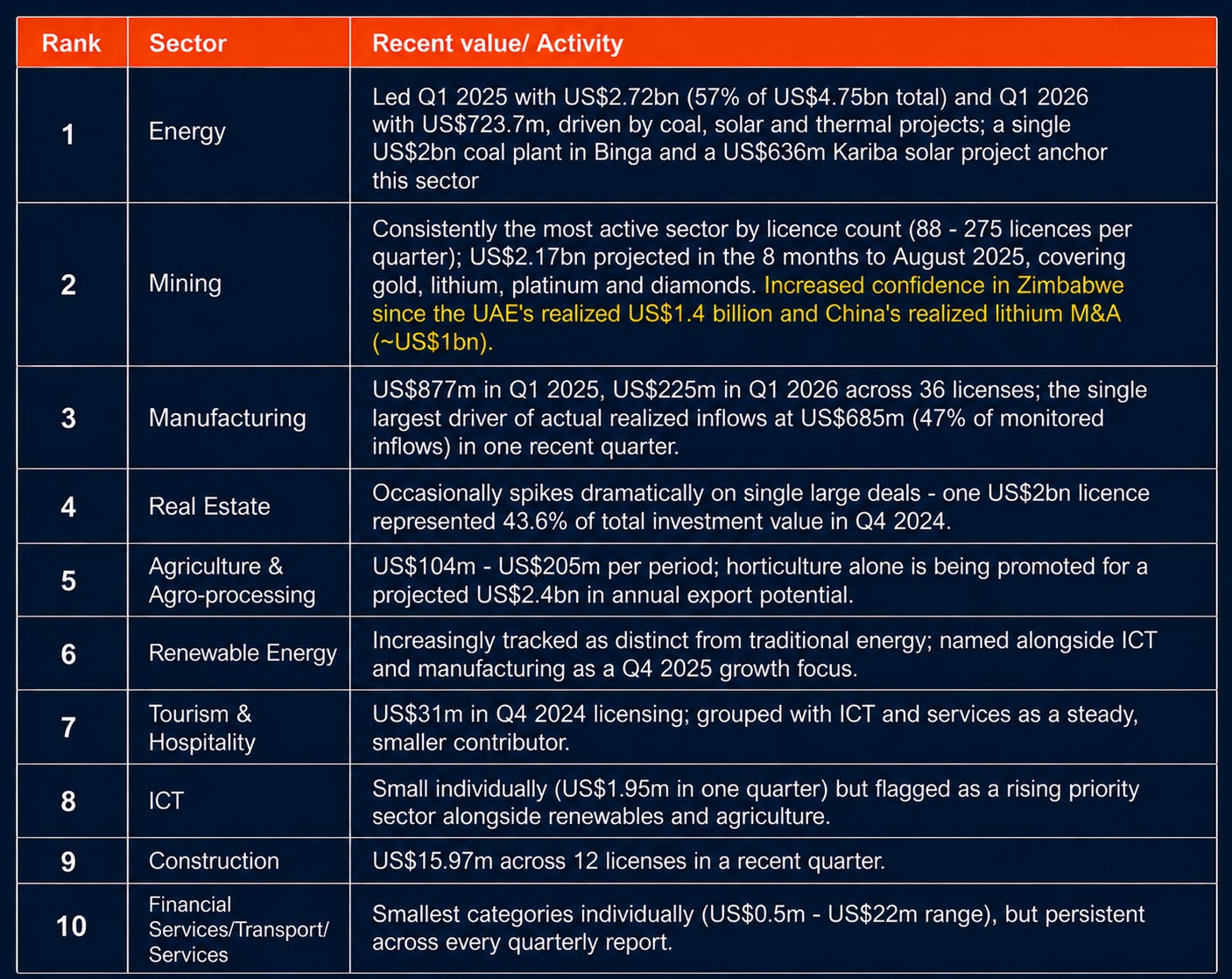
Energy, mining, and manufacturing together consistently account for 80-92% of total investment value in any given quarter. For example, they made up US$1.54bn of US$1.92bn (80%) in Q1 2026, and manufacturing plus mining plus agriculture made up 92% of one recent quarter’s actual realised inflows.
Everything else - real estate, tourism, ICT, construction, financial services - is a long tail that occasionally spikes on one-off mega-deals (like the US$2bn real estate licence in Q4 2024) but isn’t a reliable trend.
Nabii Intel is Africa’s leading independent legal market intelligence and M&A research firm, helping law firms make smarter growth decisions.

Rob Green
CEO

Data-driven legal executive search that secures game-changing talent for ambitious law firms.

Global and VIP networking events and business development opportunities for the legal community.

Africa’s leading independent legal market intelligence firm, helping law firms make smart growth decisions.

Our articles offer insight by thought leaders from across legal markets in Africa, Asia and other developing economies.

