


Empowering legal professionals
Make us your partner, to help you gain the competitive advantage you seek.
Make us your partner, to help you gain the competitive advantage you seek.

In 2020, average profit per equity partner across the Am Law 100 was approximately US$2.23 million. By 2024, it had reached US$3.15 million - a 41% increase in just four years.
At the leading firms, the numbers are now in an entirely different category. Kirkland & Ellis is reported to have reached approximately US$11.1 million in profit per equity partner in 2025, with Wachtell and other elite firms approaching or exceeding US$9 million.
At the same time, something equally consequential is happening underneath the compensation numbers.
Artificial intelligence is moving into mainstream legal practice. Alternative legal service providers are expanding rapidly. Corporate legal departments are bringing more work in-house. Clients are pressing harder on price. The traditional associate pyramid is starting to look economically vulnerable.
And yet law-firm profitability continues to rise.
What, precisely, is driving the extraordinary economics of the modern law firm, and how durable are they?
The answer may determine whether today’s US$10 million partner is the prototype of the lawyer of the future or the beneficiary of the final, highly profitable phase of the traditional billable-hour model.
The headline growth in partner profitability is remarkable. Average Am Law 100 profit per equity partner (PEP) increased 41% between 2020 and 2024, including growth of 11.6% in 2024 alone. At the elite end of the market, reported PEP has risen even more.
Profit distribution is becoming increasingly concentrated. Top-tier US firms reportedly generate net margins of 45–55%, compared with about 14–23% for much of the UK mid-market. The gap in PEP is even more striking:
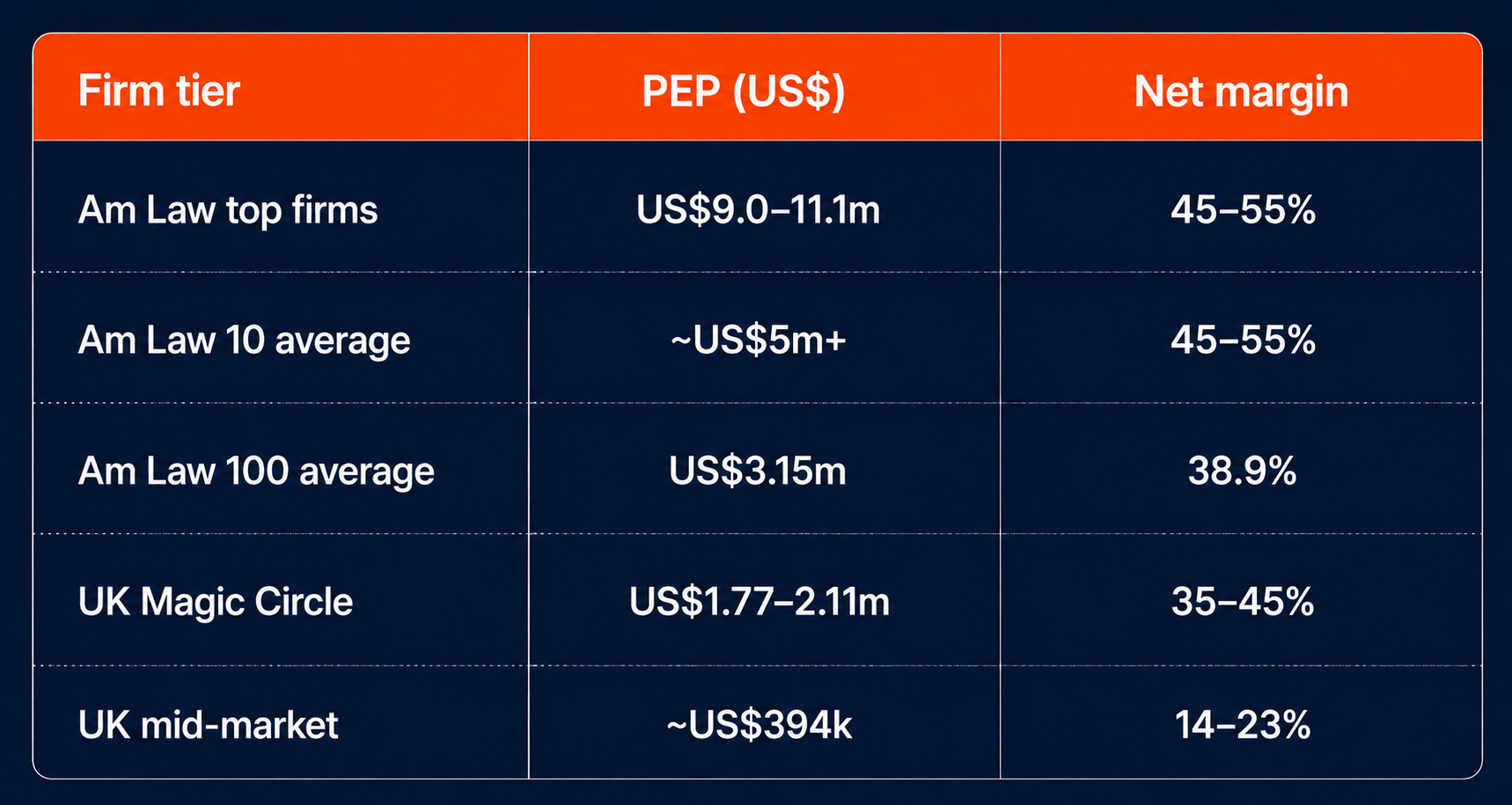
The difference is not merely one of compensation. Revenue per lawyer is also substantially higher at elite firms - approximately US$1.3–1.8 million at the top end compared with roughly US$0.5–0.7 million in the UK mid-market.
The data therefore allow two possible readings. One is that the legal market is becoming dangerously bifurcated: extraordinary profits at the top are coexisting with deteriorating economics further down the market. The other is that the numbers reveal genuine differences in productivity, pricing power, client mix, technology investment, and the scarcity of sophisticated legal judgment.
The distinction matters because one interpretation suggests fragility while the other suggests that the concentration is rational - and potentially capable of continuing.
Perhaps the most revealing data point is not PEP itself but the relationship between rates and demand.
Legal work rates have increased by approximately 6–9% annually in recent years. Yet billable-hour demand had been much less impressive through parts of 2023 and 2024, when demand was described as flat to slightly negative before returning to modest growth.
That creates an unusual economic pattern: prices are rising much faster than some measures of volume. There are at least two ways to understand it.
The first is that law firms are extracting more revenue from a relatively finite pool of client work. If hours remain stagnant but the price per hour continues to rise, partner profitability can increase without any underlying expansion in legal activity. The second is that the unit being sold is changing.
If technology enables a lawyer to produce in two hours what previously required ten, the decline in hours does not necessarily mean a decline in value. It may mean that the service has become substantially more productive. The distinction is critical.
A market in which clients pay more because lawyers are delivering greater value is behaving very differently from one in which lawyers charge more because they have retained pricing power over a shrinking quantity of work. PEP data alone cannot tell us which is happening.
The latest data make the picture even more complicated. Thomson Reuters reports that US legal demand grew 1.9% in 2025, with billable hours up 3.9% year over year in the third quarter, while worked rates rose 7.3% and average law-firm profits rose 13%.
That weakens any simple claim that recent profit growth came solely from rate increases amid falling demand. But the distribution of that demand is revealing.
Midsize firms experienced approximately 5% demand growth in the second half of 2025 compared with roughly 2% for Am Law 100 firms. Corporate clients also spent less per hour on average despite the 7.3% increase in worked rates.
The market may therefore be experiencing strong demand growth and redistribution of demand at the same time. That is a much more interesting phenomenon than simple market expansion.
Artificial intelligence makes this distinction unusually difficult.
The evidence on AI adoption is already striking. Clio data show that 79% of legal professionals were using AI in some capacity in 2024, compared with 19% in 2023. It also estimates that generative AI could potentially automate about 74% of hourly billable work.
Thomson Reuters’ Future of Professionals research is similarly consequential: 80% of legal professionals surveyed expect AI to have a high or transformational impact on their work within five years. The technology is also expected to save legal professionals substantial amounts of time as adoption matures.
If those numbers are even approximately right, the traditional relationship between lawyer hours and law-firm revenue cannot remain unchanged.
But automation does not necessarily imply falling partner compensation. It depends on what it automates. Documentation, data collection, research, analysis, and other routine activities are increasingly susceptible to technological substitution. These are precisely the activities traditionally performed by associates and other junior lawyers.
That creates the possibility of a dramatic change in the law-firm cost base.
The traditional model might be represented as:
Partner → senior associate → junior associate → large volume of human execution
The emerging model could look more like:
Partner → AI-enabled execution → much smaller human team
If that happens, the economics of leverage change fundamentally. A partner may supervise substantially more work with substantially fewer people beneath them. The result could be fewer lawyers overall, but higher profit per remaining equity partner.
The implications for the associate model are potentially profound.
AI could reduce junior-lawyer roles by 15–30%, while improving operating margins by as much as eight percentage points. These are projections, not established outcomes, but the economic direction is significant.
Law firms historically created leverage by placing large numbers of relatively expensive associates beneath relatively scarce partners. AI potentially creates a different form of leverage. Instead of adding another associate, the firm can add another technological capability.
Instead of billing ten lawyers for ten hours, it may eventually be possible for one highly experienced lawyer, supported by AI, to produce the equivalent output. This could compress the traditional pyramid from the bottom upward.
Firms are already changing their workforce composition. Thomson Reuters has identified a shift toward more experienced lateral hires, growth in two-tier partnership structures, and less emphasis on hiring junior associates.
In the UK mid-market, the ratio of fee earners to equity partners reportedly increased from 7.6 to 10.6. That is a substantial change to the firm's economic structure. The immediate consequence may be painful for the junior end of the profession. Economically, however, it could be extremely attractive for equity partners. If the firm can maintain revenue while reducing production costs, profit margins increase. And if fewer equity partners share those profits, PEP increases again.
Suppose AI reduces the time required to complete a piece of legal work by 70%. Who receives the benefit? There are three possibilities. The firm can retain it as margin, the client can receive it through lower fees, or they can split the economic value between them.
44% of legal professionals globally expect AI to reduce billable-hour pricing within five years. At the same time, many alternative fee arrangements remain anchored to the economics of hourly billing, allowing firms to retain some efficiency gains rather than automatically passing them through to clients.
The latest market data suggest that the pricing question is becoming real.
Thomson Reuters reports that corporate clients spent less per hour on average in 2025 even as law-firm worked rates increased 7.3%. Its analysis describes a growing redistribution of work from premium-priced firms toward lower-cost alternatives.
This is one of the most important variables to watch. If AI becomes widespread but effective rates remain high, firms are demonstrating an ability to convert productivity into pricing power. If AI adoption rises and effective client pricing falls, the productivity dividend is migrating toward clients. The answer may also differ dramatically by type of work.
Corporate legal departments are already exerting pressure on the traditional model.
Altman Weil research shows that 95% of chief legal officers said outsourcing to non-law-firm vendors produced significant improvements in cost control, while 93% cited shifting work in-house. Other strategies included portfolio price reductions at 91%, hourly-rate discounts at 86%, and alternative fee arrangements at 82%.
Clients are not passive recipients of law-firm pricing. They are actively experimenting with substitutes.
The growth of alternative legal service providers reinforces the trend. Estimates place the global ALSP market at between approximately $20.6 billion and $28.5 billion, with annual growth rates ranging from 8.3% to 18%. The work being captured is precisely the work most exposed to commoditisation: e-discovery, contract drafting, compliance monitoring, and due diligence.
Meanwhile, corporate legal departments are developing their own technological capabilities. AI adoption among in-house legal professionals is at 78%, with more than two-thirds of organisations planning to increase generative-AI investment in legal departments in 2027. This creates an important dividing line within legal services.
If AI and ALSPs primarily remove lower-value execution work, elite advisory practices may become more valuable. If they progressively move upward into complex analysis and judgment, the premium attached to elite lawyers becomes harder to defend.
The economics of the profession may therefore depend less on whether AI “disrupts law” than on which parts of legal work it disrupts first, and how far upward it moves.
Professional-services businesses have repeatedly demonstrated that exceptional compensation can coexist with deteriorating structural fundamentals. The most obvious comparison is investment banking before the financial crisis.
Goldman Sachs’s compensation pool reached about US$20.2 billion in 2007, roughly 44% of net revenue. Lloyd Blankfein received approximately US$68.5 million that year. Lehman Brothers also paid record bonuses in 2007, only months before its September 2008 collapse.
The relevant similarity is not that law firms are banks. It is that extraordinary compensation can persist while the assumptions supporting it are becoming more fragile.
Dewey & LeBoeuf provides a closer legal precedent. The firm guaranteed some partners compensation of up to US$6 million annually and built a cost structure around continued revenue growth. When that growth failed to materialise, the fixed commitments became unsustainable. Dewey ultimately filed for bankruptcy in 2012 with more than US$315 million in debt.
The lesson is not that today’s elite firms resemble Dewey. They plainly do not.
It is that compensation based on expected future revenue can become a source of fragility when the assumptions supporting that revenue change faster than the compensation structure does. The legal market has experienced smaller versions of this cycle before.
AmLaw 100 profits per partner peaked at approximately US$1.5 million in 2007–08 before falling by roughly 5–10% during the financial crisis. Heller Ehrman collapsed in 2008. Thelen Reid followed. Howrey failed in 2011. Yet history also points in the other direction.
Electronic trading did not destroy the dominant investment banks. The top five investment banks increased their share of global investment-banking fees from approximately 55% in 2000 to more than 70% by 2015, according to the data in the underlying analysis.
Technology eliminated labour-intensive activities, but the institutions with the capital, infrastructure, and client relationships to deploy it captured much of the resulting productivity gain.
Management consulting provides another example. McKinsey’s revenue rose from approximately US$7 billion in 2012 to more than US$16 billion by 2023, alongside rapid growth in analytics and digital capabilities.
Technology can therefore produce two radically different outcomes. It can undermine an incumbent business model. Or it can make incumbents substantially more powerful. The question is which mechanism is operating in legal services.
There is a powerful argument that technology could make the most experienced lawyers more valuable, not less.
Consider a major acquisition, regulatory investigation, or high-stakes litigation. The value of the legal advice may depend more on the quality of strategic judgment than on the number of hours spent reviewing documents.
If AI can analyse millions of pages, identify patterns, synthesise authorities, and surface risks in minutes, the partner may enter the strategic conversation with a far richer information base. The lawyer is no longer paid primarily to process information. The lawyer is being paid to decide what matters. That is potentially a much more valuable service.
The LexisNexis CEO forecast that AI could ultimately support partner rates approaching US$10,000 per hour. Whether that precise figure proves realistic is less important than the economic mechanism behind it.
If AI dramatically increases the amount of value that can be created in one hour of senior judgment, the market may rationally pay much more for that hour. Under that model, falling hours and rising rates are not contradictory. They are the natural consequence of increasing value density.
The gap between the top and bottom of the legal market is now so large that it demands explanation.
A Kirkland partner reportedly generating more than US$11 million in PEP operates in a completely different economic environment than a mid-market partner generating less than US$500,000. The question is whether the gap is temporary or structural. The evidence supporting structural differentiation is substantial.
Elite firms tend to have higher-value practices, stronger global client relationships, greater pricing power, and significantly greater resources for technology investment.
At the top end of the market, revenue-per-lawyer growth has grown by more than 25% since 2020. But extreme concentration can also become self-reinforcing.
High profits allow elite firms to recruit the best partners. Those partners bring clients. The clients generate more revenue. The revenue funds greater technology investment. Technology increases productivity. Higher margins fund further lateral recruitment. The process can produce a positive feedback loop.
The latest market data provide an intriguing complication. In the second half of 2025, midsize firms saw nearly 5% demand growth, compared with about 2% at Am Law 100 firms. That suggests that redistribution of legal work is not merely a theoretical threat to the middle of the market. Some clients are already moving work downstream.
The question is whether that migration concerns mainly price-sensitive, commoditised work or whether it eventually reaches matters for which elite firms have historically been considered indispensable.
The profession’s future supply is also changing.
The US attorney population fell by about 7,163 lawyers between 2023 and 2024 - the largest decline in the decade cited in the analysis.
The future associate pipeline is also weakening. The counter-analysis cites a 20% decline over the past decade and reports that only 14% of UK mid-market associates express strong interest in becoming partners, while 43% say partnership is perceived as less desirable than previously.
Those numbers could indicate a profession losing its attractiveness. But they could also describe a profession becoming economically more selective.
If firms need fewer junior lawyers because AI is taking over execution work, declining enthusiasm for traditional associate careers may partly reflect an accurate perception of where the profession is heading.
The result could be a smaller pyramid with a much more valuable apex. That would be economically consistent with rising PEP. It would also profoundly disrupt the traditional career model.
Another issue hidden beneath the headline PEP figures is how firms decide who gets paid. Origination explains approximately 64% of the variance in partner compensation at major firms, while origination combined with billing-rate performance explains approximately 72%.
By contrast, activities such as leadership, mentoring, collaboration, and innovation appear to explain substantially less. That creates an institutional problem.
A compensation system designed primarily around origination and rates rewards partners for maximising revenue today. But the firm’s long-term competitiveness may depend on activities that do not immediately generate revenue, including building technology, redesigning workflows, training lawyers, developing new products, and changing the way services are delivered.
The issue is therefore not simply whether compensation is high. It is whether the compensation architecture is optimised for the emerging economic model.
If AI eventually compresses traditional legal work, the firms best positioned to survive will not necessarily be those with the highest current PEP. They may be those that have successfully converted today’s profits into tomorrow’s capabilities.
The evidence now points to several simultaneous changes.
PEP is rising. Am Law 100 PEP increased 41% between 2020 and 2024, from US$2.23 million to US$3.15 million.
Rates are rising. The underlying analysis puts annual rate growth at approximately 6–9%, while the latest Thomson Reuters data show worked rates increasing 7.3% in 2025.
Demand is rising, but unevenly. Billable hours increased 1.9% across 2025, with quarterly growth reaching 3.9% in Q3. But smaller firms captured substantially more of the growth than Am Law 100 firms.
Technology spending is accelerating. Thomson Reuters reports that technology spending rose 9.7% in 2025, while talent costs also increased materially.
AI exposure is substantial. It is estimated that 74% of hourly billable work could potentially be automated.
AI adoption is accelerating. The cited Clio data show adoption rising from 19% to 79% among legal professionals between 2023 and 2024.
Alternative providers are growing. The ALSP market is estimated at US$20.6–28.5 billion, with annual growth of approximately 8.3–18%.
Clients are building alternatives. Altman Weil’s research found that 93% of chief legal officers identified shifting work in-house as a cost-control strategy, while 95% cited outsourcing to non-law-firm vendors.
The economics are bifurcating. Elite firms are operating at margins of approximately 45–55%, versus roughly 14–23% in the UK mid-market.
The leverage structure is changing. The UK mid-market fee-earner-to-equity-partner ratio cited in the analysis increased from 7.6 to 10.6.
The supply of future partners is becoming less certain. Only 14% of UK mid-market associates reportedly express strong interest in partnership.
And the compensation system remains heavily tied to revenue generation. Origination alone reportedly explains 64% of compensation variance, rising to 72% when billing-rate performance is included.
Taken together, these figures describe a profession in which the traditional relationship between human labour and economic value is being rewritten.
A sustained technology-driven remuneration boom would be expected to produce several characteristics simultaneously.
A correction would look different:
The interesting point is that some of these indicators are already moving in both directions. Rates remain exceptionally strong. Profits remain exceptionally strong. Demand remains strong. But demand is moving toward less expensive firms.
Clients are paying less per hour despite rising headline rates. Technology spending is increasing rapidly. Firms are also reducing their historic dependence on junior lawyers.
That is not the pattern of a simple boom. Nor is it yet the pattern of a conventional collapse. It looks more like a market redistributing economic value.
The critical question is not whether lawyers will become more productive. It is who will capture that productivity.
If the answer is primarily elite lawyers and their firms, the US$10 million partner may be the beginning of a new economic model in which scarce judgment commands an extraordinary premium.
If the answer is increasingly clients, today’s PEP figures may represent the high-water mark of the traditional model.
And if the answer differs by segment, the result could be even more disruptive. A small number of highly profitable firms at the top, a rapidly shrinking middle, and a large amount of routine legal work migrating to AI, ALSPs, and corporate legal departments.
The numbers already show that this transition has begun. What they do not yet show is where the economic surplus will ultimately settle.
For weekly opinion pieces, market reports, jobs, and global event updates, subscribe to our SubStack newsletter.

Rob Green
CEO

Data-driven legal executive search that secures game-changing talent for ambitious law firms.

Global and VIP networking events and business development opportunities for the legal community.

Africa’s leading independent legal market intelligence firm, helping law firms make smart growth decisions.

Our articles offer insight by thought leaders from across legal markets in Africa, Asia and other developing economies.

